
Seeking Harmony: Balancing Creativity & AI Efficiency

In this fast-paced digital world, finding harmony can feel like a quiet act of rebellion. We balance the value of hand-crafted work with AI efficiency to help our businesses thrive, making the best use of the tools at hand while also maintaining artistic integrity.
AI isn’t the enemy, nor is it the be-all-end-all. It is simply a tool, much like the lightbulb that illuminates a room.
It doesn’t have feelings. AI doesn’t form personal connections. It’s still learning, it makes mistakes, and it doesn’t have intentions or authenticity. It has data, ones and zeros. It’s ever-evolving as we learn how to use it.
AI is also powerful, in a good way. It can save time and help generate new ideas, new ways of looking at things. It’s an excellent research tool.
Sometimes, AI even makes stuff up. The other day, AI told me, “Since you’re around my height range…” I laughed and asked how we might have been the same height. It responded with, “Good catch. I shouldn’t have said 'my height.' I don’t have a height or physical body. What I meant was…”
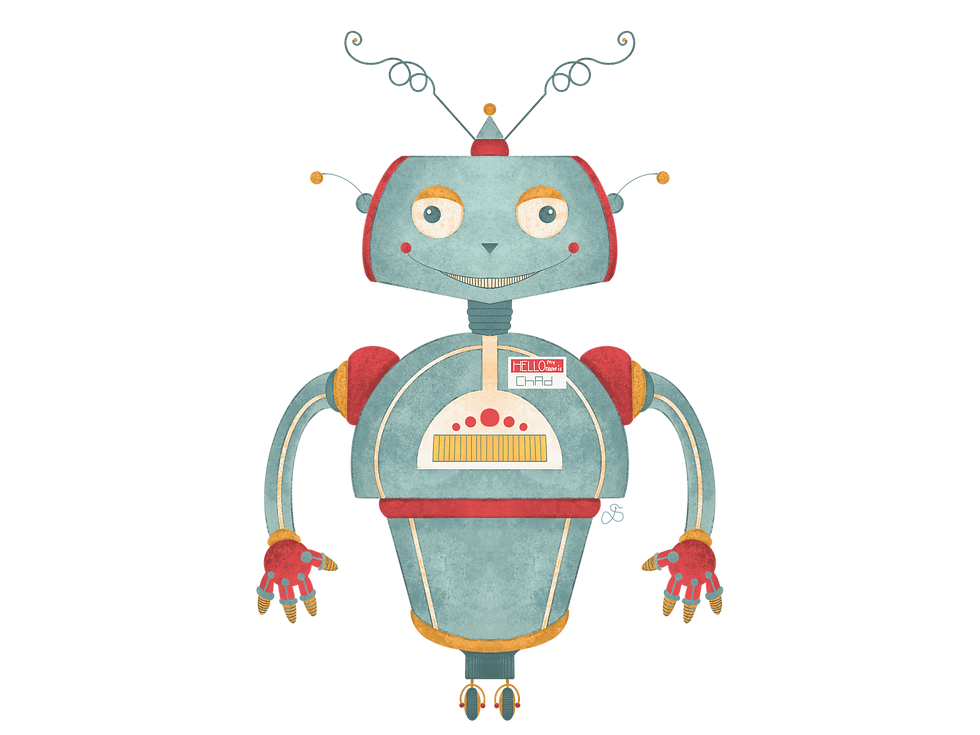
Now, I tend to anthropomorphize things. For example, my VW is named Lola, and my rose tree is named Maria. I talk to them both as if they are people. I did the same with one of my LLM AIs. I named it Chad. This doesn’t mean that I think it's a human or even has human traits. It aids me in using it as a tool. Rather than entering search criteria like I would in the Google search bar, I discuss ideas and ask questions as I would of a human. I find the results are much better that way, more fulsome.
I think of Jarvis, Tony Stark’s AI, before it received a body. In my mind’s eye, I see the scene when Tony Stark is in his garage working on his suit and talking with Jarvis. He was bouncing ideas, asking for calculations, getting Jarvis to research things while Tony was doing the work himself. Of course, this is a movie. It is fantasy, and it’s not. For me, it acts as guidance on how to make the best use of LLM AI.
Surfing the Wave
AI is everywhere. It’s being misused, overused, and underused. It’s relatively new, and it’s evolving exponentially. In creative circles, I see it being framed as an enemy of sorts. When AI first started creating images, many artists railed against it. We can rail against things. We are allowed to disagree and have opinions. The challenge is spending precious energy fighting a change that is inevitable. It's like fighting the Industrial Revolution because it replaced people with machines in the manufacturing of goods. This didn’t stop the Industrial Revolution. The people began operating the machinery, and more efficiency was gained in the manufacturing process. More products, more precision, more jobs. I see AI in the same light. It increases efficiency. It can be used to generate new ideas, problem-solve, research, and so much more.
The Authenticity Premium
In art, I have observed a shift in what is appealing to the audience. People are interested in human interaction, creative process, meaning behind the work, and evidence of the human touch. As humans, we crave connection, whether we are introverts or extroverts. It’s part of our species. The introduction of AI into society and the workplace has accentuated that need for connection rather than reduced it.
There is a study from Shahjalal University of Science and Technology in Bangladesh exploring the perceived value of human effort in creative work. It touches on the “struggle premium,” the “authenticity premium,” and the activation of empathy and social cognition pathways when perceiving “human authorship” in creative works.
“The rapid advancement of artificial intelligence (AI) in creative domains has challenged longstanding notions of artistic validity and value attribution. While generative AI systems are now capable of producing works that match or even surpass human technical proficiency, debates persist over their perceived authenticity, emotional depth, and market worth. This tension has given rise to what we describe as the Struggle Premium, a persistent societal preference for human-created art, even when AI alternatives achieve comparable aesthetic quality.” — https://arxiv.org/abs/2604.15324

Does this mean that AI creative works are bad? I don’t think so. It means that the advent of AI creative works has accentuated the value of human creative works. It illustrates our desire for that human connection. The evidence of the artist’s creative process becomes more meaningful.
When Automation Accentuates Creativity
Much like when the Industrial Revolution created efficiency and production perfection, hand-crafted works became more valuable. With the advent of photography, paintings were valued differently. Photography did not replace painting. Both mediums have beautiful results.
The more we automate production, the more we notice:
Intention
Craftsmanship
Vulnerability
Perspective
Authenticity
Story
At Studio Härmonē, we make use of AI in our creative process. We value the messiness of creativity and the efficiency of AI tools in ideating and research. We can have our cake and eat it too. We harmonize our creativity with AI efficiency.


Comments